

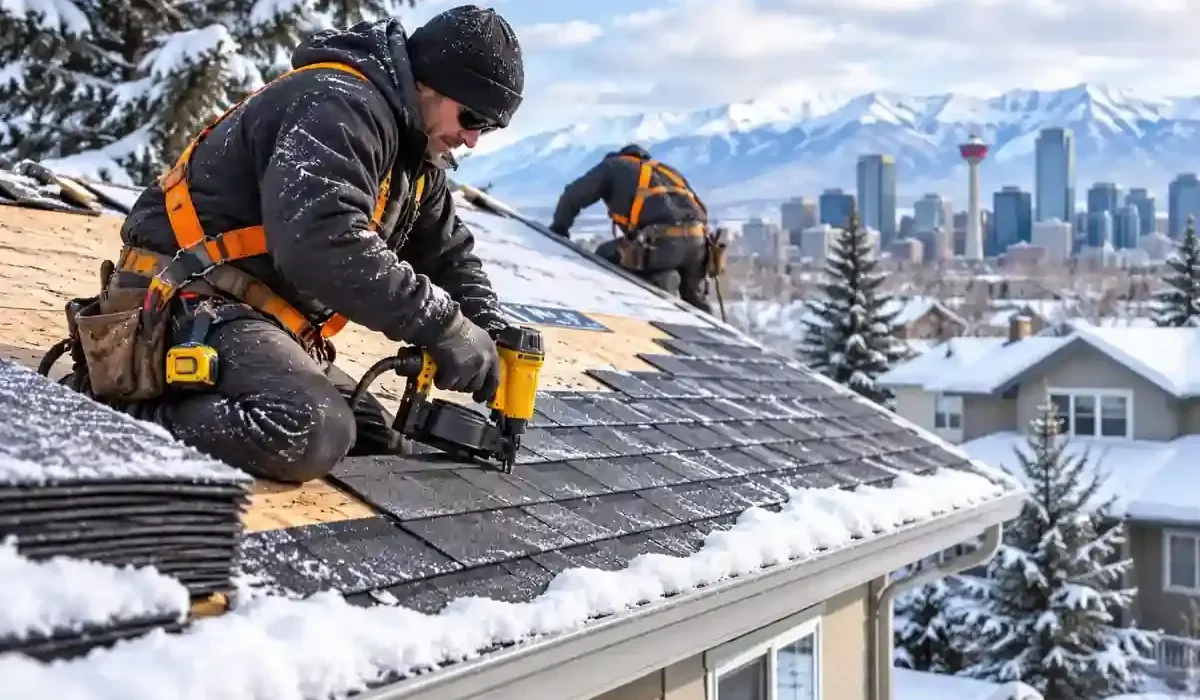
Yes. Roofs are replaced in Calgary in January and February, and cold weather does not automatically make the finished roof worse. What changes is the method. Shingles get hand-sealed instead of relying on the sun, materials stay warm until the moment they go down, and the schedule bends around snow, wind, and daylight.
What a Calgary Winter Does to a Roofing Job
Calgary gives roofers two conditions that most Canadian cities do not: chinook winds that can push daytime temperatures above freezing for days at a time, and a fast return to hard cold once they pass. Those swings open work windows in the middle of winter. They also mean the roof surface can go from slush to ice overnight.
Three things slow the work down.
Snow removal comes first. Before tear-off, the crew clears the roof. That is hours of shovelling that does not exist in July.
Frozen or wet sheathing comes second. Once the shingles are off, the deck has to be dry enough to take underlayment. A soaked or iced deck gets swept and dried, or the crew waits for a better window.
Shorter days come third. Daylight sets the practical limit for a winter crew, so a job that runs ten hours in June might run seven in December.
None of that makes the roof defective. It makes the job slower and more dependent on the forecast.
Temperature Limits by Material
Shingle and membrane manufacturers publish application temperatures, and the numbers vary by product. The figure that comes up most often for asphalt shingles is about 4°C (40°F), below which the factory sealant strip will not bond on its own. Treat it as a general threshold and read the bundle for the actual product.
| Material | What cold weather does | What an experienced crew does |
| Asphalt shingles | The mat turns brittle and the sealant strip stops activating | Keeps bundles warm, carries them flat, hand-seals each tab with roofing cement |
| Metal panels | Panels expand and contract, and long sheets are hard to control in wind | Works in calmer windows, follows fastener and torque specs, uses cold-rated sealants |
| EPDM and TPO membrane | Adhesives and primers have minimum application temperatures | Switches to contact adhesive or mechanical attachment, or waits for a warmer window |
| Modified bitumen | Torch application is sensitive to wind, snow and surface moisture | Works in sheltered sections and follows the manufacturer’s limits |
For flat roofs, the system matters more than the season. Mechanical attachment and cold-rated adhesives leave more room than a system that depends on solvent-based bonding in deep cold. That is worth sorting out before the crew arrives, and it is one reason flat roofing systems in Calgary and Edmonton get specified differently from shingled roofs.
Installing Asphalt Shingles in Cold Weather
Asphalt shingles are the most common residential covering in Calgary, so this is where winter work succeeds or fails.
Keep bundles warm until they go down. A heated trailer, a garage, or a covered stack off the frozen ground all work. Shingles that have sat at -20°C all morning crack when they are bent.
Carry shingles flat, not over the shoulder. Bending a cold shingle fractures the mat, and a fractured mat is a shingle that fails early.
Work the warm part of the day. Late morning to early afternoon is usually the softest window in a Calgary winter.
Hand-seal every tab. A dab of roofing cement under each tab replaces the heat of the sun. This is the most common cold-weather step, and the one worth asking about directly.
Nail into the nail line. Cold shingles fracture easily, so high nails and overdriven nails are the defects an inspector finds first.
Sweep the deck. Snow and ice come off before underlayment goes down, not after.
Underlayment behaves differently too. Self-adhered membranes need a clean, dry surface and often some warmth to bond. Synthetic underlayment can be rolled out in colder conditions but still has to lie flat before shingles go over it. A crew that rushes this step leaves wrinkles that show up later as wear.
Wind sets the second limit. Lifting bundles and rolling out underlayment in gusting wind is unsafe, and it produces wrinkles that never flatten once the weather warms.
Snow, Ice and Wind on a Winter Roof
Safety on a winter roof comes down to ice, wind, and cold stress. Crews clear snow from the work area and from every walking path, wear fall protection anchored above the eave, and stop when wind makes sheet goods unmanageable. Ladder feet get checked for ice, and cords, hoses, and debris stay off walkways that will freeze overnight. Sealant and adhesive containers are kept above freezing so the product actually cures.
Snow getting into the attic through an open deck is a winter problem too. A crew working in cold weather should close each section before the end of the day, and many work in smaller sections so the roof is never fully open.
For the homeowner, the practical version is shorter. Ask where the crew anchors, ask how debris and meltwater get kept out of the gutters, and expect several days when nobody is on the roof.
A winter replacement is also the right time to look at attic ventilation and insulation. The ice dams that form on Calgary roofs in February usually start with warm air leaking into the attic, and adding ventilation while the deck is open costs far less than tearing into it later.
How Long a Winter Roof Replacement in Calgary Takes
According to a published estimate from a US contractor, winter work takes about 20 to 30 percent longer than summer labor. Although the exact number has not been verified for Calgary conditions, the causes—snow removal, hand sealing, reduced daylight, and days lost due to wind and snow—are evident here.
Material lead time is a separate variable. Shingle and membrane orders can take longer in winter if the local supplier does not stock the colour or profile, so confirm the material is on hand before a tear-off date is set.
Plan for weather days to be built into the schedule from the start. A contractor who quotes a winter job with no allowance for weather has either not done many or is planning to leave your roof open. Ask what happens if snow arrives mid-job, and how the roof gets dried in before the crew leaves each day. Once the roof is clear, a full roof replacement in Calgary is usually a matter of days rather than weeks. The variable is how many of those days the weather allows.
Is a Winter Replacement Cheaper?
Sometimes, but not consistently. Between November and March, demand declines, giving crews greater negotiating leeway and open days. However, the cost of materials does not decrease with temperature, and labor costs are increased for tasks requiring additional snow removal, drying time, or temporary heat, which reduces any savings.
The dependable advantage is the calendar. In June, a homeowner with an aging roof waits weeks for a crew. In January, a crew that would otherwise be idle can often start sooner. Calgary roof replacement costs are driven more by roof size, material, the number of layers to remove, and deck condition than by the month on the calendar.
When Waiting for Spring Is the Wrong Call
If the roof is leaking now, waiting has a cost. Water that gets past the shingles soaks decking, insulation, and ceiling drywall, and every freeze-thaw cycle makes the damage more expensive to fix. A tarp or a targeted repair can bridge a few months, but it has to be installed properly and checked after each storm. 24/7 emergency roof repair in Calgary exists for the cases where a tarp will not hold.
Three situations push a replacement into winter.
An active leak, or a ceiling stain that grows after each snowfall.
A real estate transaction. Buyers, lenders, and insurers ask about roof condition, and a pre-sale roof inspection with photos answers those questions faster than a promise to replace in May.
An insurance claim. Storm and hail claims have policy deadlines, and hail damage roof repair in Calgary often starts as a documented temporary repair rather than a delay.
Choosing a Contractor for Winter Work in Calgary
Questions worth asking before you sign.
- How do you hand-seal shingles in cold weather? A crew that has done this answers in specifics.
- How are bundles stored on site? “In the truck” is not an answer in January.
- How many winter replacements did you complete last season?
- Will you pull the permit, and is one required for this scope?
- What does the manufacturer’s warranty say about installation temperature?
- Who is on the crew, and are they covered by workers’ compensation and liability insurance?
The answers matter more than the pitch. A contractor who says winter roofing is impossible is describing their own operation, not the trade. There is a longer list in this guide to choosing a roofing contractor in Calgary or Edmonton.
Permits, Codes and Warranty Terms to Confirm
Whether a permit is required depends on what is being replaced and how much of the structure changes, and City of Calgary requirements should be confirmed for the specific project rather than assumed. Ask who is responsible for the permit and get the answer in writing.
Before you rely on a warranty, read the installation instructions provided by the manufacturer. Installation in cold weather is not always disqualified, but certain materials have minimum application temperatures, and a claim becomes more problematic if the job was done outside of those parameters. Before construction starts, seek the contractor’s written opinion if the forecast is questionable.
What It Means If Your Roof Is Failing Now
Cold weather changes the method, the schedule, and sometimes the price. It does not change whether a roof can be replaced. Winter jobs that go wrong usually involve a crew that skipped the hand-sealing, worked through wind because the calendar said so, or left the deck open overnight.
If you are weighing a winter replacement against a spring wait, the useful next step is an inspection with photos of the actual deck and shingles rather than an opinion formed from the driveway. Residential roofing in Calgary starts there either way.
FAQ
Can shingles be installed below freezing?
They can be placed, but each tab must be manually sealed with roofing cement because the factory sealing strip won’t activate on its own in the cold. Because manufacturers and shingle lines have different limits, make sure to check the application temperature listed on the product’s bundle.
Does installing a roof in winter void the shingle warranty?
A claim may be difficult if the installation took place outside of the minimum application temperature stipulated by some manufacturers, although this is not always the case. Ask the contractor to explain in writing how the cold-weather work will comply with the published installation guidelines.
Can a roof be replaced while there is snow on it?
Before tear-off, light snow is removed using shovels and brooms. The process is typically delayed by heavy accumulation, active snowfall, or ice on the deck since the sheathing must be sufficiently dry to receive shingles and underlayment.
How is the house protected while the roof is open in winter?
To ensure that the roof is never completely removed, some crews work in smaller parts and shut the exposed portion before departing each day. Find out how the contractor dries the roof overnight and what happens if snow falls in the middle of the project.