
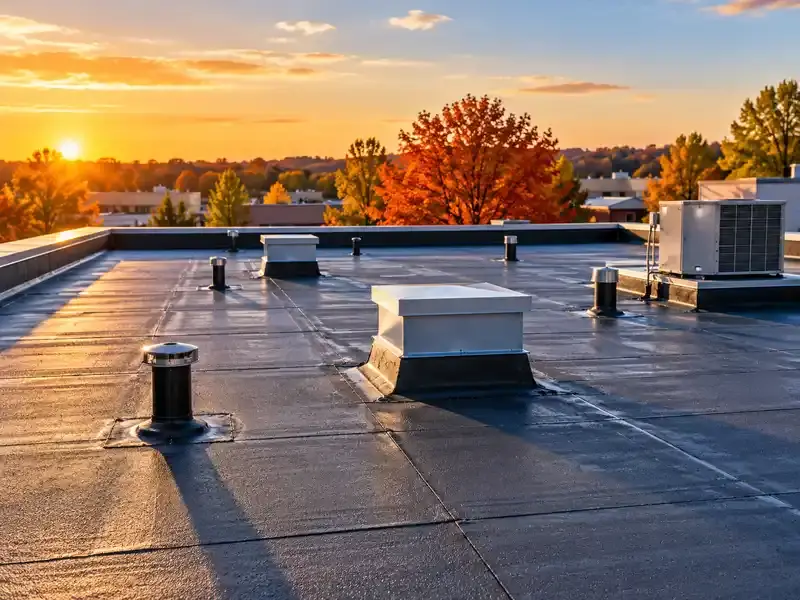
If you own or manage a commercial building in Calgary, a flat roof maintenance checklist is the single most useful tool for avoiding surprise leaks, tenant complaints, and expensive emergency calls. Maintaining a commercial flat roof here is not simply about looking for leaks after a storm. A proper maintenance program tracks drainage, ponding, membrane condition, seams and laps, flashing, penetrations, parapets and coping, rooftop HVAC equipment, roof traffic, structural warning signs, interior evidence of moisture, seasonal weather exposure, past repairs and warranty documentation, all working together as one system. For businesses that already rely on Calgary roofing services, this guide is meant to sit alongside that relationship, not replace it, by giving you the working knowledge to spot problems early and ask better questions when a roofer is on site.
Commercial roofs in Calgary endure a harsh yearly cycle that includes freezing and thawing during the winter, snowfall, spring melt, sudden hailstorms, extreme summer UV, and wind events that can lift or stress roofing components in a single day. This book provides Calgary businesses with a seasonal calendar, an inspection plan, a practical maintenance checklist, a priority system for determining what needs to be fixed first, and a framework for making decisions about what needs to be monitored, what needs to be repaired, and when to contact a commercial roofer.
Quick answer: A flat roof maintenance checklist for a Calgary commercial building should cover drainage, ponding, membrane condition, seams and flashing, parapets and coping, roof penetrations, rooftop HVAC equipment, roof edges, structural signs, and interior evidence of leaks. Most buildings need at least two professional inspections a year, in spring and fall, plus extra checks after hail, high wind, or heavy snow.
Why Does a Flat Roof Maintenance Checklist Matter for Calgary Commercial Buildings?
Why Is Calgary’s Climate Harder on Commercial Flat Roofs?
Calgary’s freeze and thaw cycles, heavy snow loads, rapid spring melt, summer hail and strong winds put more stress on a flat roof than a stable climate would. Low-slope commercial roofs in Calgary deal with a wider range of stress than most other Canadian cities see in a single year. Freeze and thaw cycling causes materials to expand and contract repeatedly, which gradually loosens fasteners, opens seams, and stresses sealants. Snow sits on the roof for extended periods, then melts quickly during a Chinook, sending water toward drains that may still be partially frozen. Rapid temperature swings put pressure on membrane seams and flashing details that were never designed for constant movement.
Add to that spring drainage demands, strong summer UV exposure that breaks down membrane surfaces over time, seasonal hail that can bruise or puncture roofing materials, and wind events strong enough to lift loose edge metal or coping. Rooftop equipment and regular foot traffic add mechanical wear on top of all of this. Water that lingers on a low-slope surface after any of these events is often the first visible sign that something underneath needs attention.
What Happens When Small Roof Problems Are Ignored?
Ignored roof problems get worse in stages: a small deficiency lets water in, the water saturates insulation, the deck deteriorates, and the damage eventually reaches the building’s interior. Roof failures rarely start as failures. They start as small deficiencies. A pinhole in a membrane, a slightly separated seam or a clogged drain strainer may seem insignificant on their own. Left alone, that small deficiency allows water intrusion. The water saturates insulation before it ever reaches a ceiling tile. Wet insulation loses its ability to insulate and begins to compress, which accelerates deck deterioration underneath the membrane. Eventually, that damage shows up as an interior stain, a musty smell or a structural soft spot, at which point the fix is far larger, far more disruptive, and far more expensive than it would have been at the first stage.
This is exactly why a flat roof maintenance checklist matters. Catching a problem in the deficiency stage, rather than the interior damage stage, is the difference between a routine repair and a business disruption.
What Is the Difference Between Roof Maintenance, Inspection, Repair and Replacement?
Inspection identifies problems, maintenance prevents them, repair fixes a specific defect, restoration extends an aging roof’s life, and replacement installs an entirely new roofing system. These terms get used loosely, and that loose usage causes confusion about what a building owner actually needs.
| Term | What It Means |
| Inspection | Identifies the current condition of the roof and any existing problems |
| Maintenance | Ongoing work that prevents deterioration and keeps the roofing system functioning as designed |
| Repair | Fixes a specific, identified defect |
| Restoration | Extends the useful service life of an aging roof through coatings or targeted rebuilding |
| Replacement | Installs a new roofing system when repair or restoration is no longer appropriate |
Understanding where your roof sits in this chain helps you make better decisions and avoid paying for a repair when what you actually need is a documented maintenance plan.
How Often Should a Commercial Flat Roof Be Inspected and Maintained?
Most Calgary commercial roofs should be inspected at least twice a year, in spring and fall, with additional checks after severe weather. That is the short answer. The fuller answer depends on several factors specific to your building.
| Roof Situation | Suggested Attention |
| Newer, low-risk roof | At minimum, spring and fall professional inspections |
| Typical commercial roof | Spring and fall maintenance and inspection visits |
| Older roof | More frequent monitoring throughout the year |
| High traffic roof | More frequent checks around access points and equipment |
| History of leaks | Increased monitoring and shorter intervals between checks |
| Large or complex roof | A risk-based schedule built around its specific layout |
| After hail, wind or severe weather | Event-driven inspection within days of the event |
| Heavy snow or loading concern | Additional structural and drainage assessment |
Quarterly inspections are not an absolute requirement for every Calgary roof, even though some local guidance suggests it as a blanket rule. The right frequency depends on roof age, roofing system, size, sun and wind exposure, occupancy, drainage design, and warranty requirements. Two roofs on the same street can reasonably need different schedules.
How Do You Build a Flat Roof Maintenance Schedule Around Risk Instead of Guesswork?
A defensible flat roof maintenance schedule is built around your building’s actual risk factors, not a generic calendar. Consider roof age, the specific roofing system installed, any previous leak history, how well the drainage actually performs during heavy rain or melt, the size of the building, the amount of rooftop equipment, how much tenant or contractor activity happens on the roof, exposure to severe weather, warranty requirements, and the history of past repairs. A roof with a clean history and light traffic can often run on a standard spring and fall schedule. A roof with recurring leaks, heavy equipment traffic or a known drainage weakness needs a tighter, more frequent schedule built specifically around those risks.
The Complete Flat Roof Maintenance Checklist for Calgary Businesses
A complete flat roof maintenance checklist covers 14 areas: the membrane, seams and laps, drainage, ponding, flashing, parapets and coping, penetrations, HVAC equipment, roof traffic, edges and perimeter metal, expansion joints, the roof deck, interior evidence of leaks, and repair history. Rather than a simple list of tasks, each item below explains what to look for, why it matters and what action typically follows.
1. Check the Roof Membrane
Look across the entire membrane surface for punctures, cuts, tears, blisters, cracks, splits, abrasions, general surface deterioration, exposed reinforcement, displacement, and any unusual wear pattern or storm damage. The exact warning signs vary by roofing system, so a defect that looks minor on one membrane type can indicate a more serious issue on another.
2. Inspect Seams, Laps and Terminations
Check for open seams, separated laps, failed adhesive, problems with heat-welded seams, loose terminations, membrane that has shifted out of position, and sealants that have started to deteriorate. Seams deserve special attention on single-ply commercial systems because they are engineered joints, not solid material, and they are one of the most common points where water first finds its way in.
3. Clear and Inspect Drains, Scuppers and Other Drainage Paths
Cover internal drains, drain strainers, scuppers, gutters, downspouts, overflow drains, and emergency drainage paths, checking for debris, ice, and restricted flow. There is an important difference between removing debris from a drain and diagnosing why that debris keeps accumulating in the same spot. If the same drain clogs every season, the underlying issue may be a drainage design problem rather than simple housekeeping.
4. Look for Ponding Water and Determine Why It Is Happening
Ponding water matters less for whether it’s there and more for why it hasn’t drained. Common causes include a blocked drain, a clogged scupper, inadequate slope, building settlement, damaged drainage components, problems in the tapered insulation system, structural deflection, frozen drainage or leftover snowmelt.
A frequent question is how long it is safe for water to sit on a flat roof. There is no reliable universal number that applies to every roof. Persistent ponding, meaning water that remains well beyond a normal drying period after rain or melt, should be investigated rather than assumed to be harmless just because the roof has a low slope by design.
5. Inspect Flashing Around Roof Transitions
Check wall flashing, base flashing, counterflashing, termination bars, corners, transitions between materials, and all related sealants. Transitions are common failure points because they involve two or more materials meeting at an angle, and that junction is where movement, water, and UV exposure all concentrate at once.
6. Inspect Parapet Walls and Coping
This is one of the most overlooked areas on commercial buildings and one of the strongest opportunities to catch a problem early. Check coping caps, coping joints, loose fasteners, any sign of movement, corrosion, open joints, failed sealants, cracks in the parapet itself, the membrane termination at the parapet base, and general wind exposure. Many roof leaks that appear to originate from the field of the roof actually trace back to a failed parapet or coping detail.
7. Check Roof Penetrations and Curbs
This includes plumbing vents, electrical penetrations, exhaust vents, pipes, pitch pockets, HVAC curbs, conduits, roof hatches, and any other service penetration. Every penetration through the membrane creates another transition point, and every transition point needs the same ongoing attention as a seam or flashing detail.
8. Inspect Rooftop HVAC and Mechanical Equipment
Look for equipment leaks, condensate discharge running across the membrane, curb flashing condition, vibration-related wear, equipment support integrity, damage from recent service work, and refrigerant line protection. Rooftop equipment is worth close attention on commercial buildings because roofing contractors are rarely the only people accessing the roof. HVAC technicians, electricians, and other service providers walk the same surfaces and can unknowingly cause damage during their own work.
9. Check Roof Traffic and Walk Pads
Watch for unauthorized access, repeated service routes worn into the membrane, missing or damaged walk pads, punctures near equipment access paths, and general contractor traffic patterns. A simple principle applies here: people accessing rooftop equipment should follow a designated route rather than repeatedly walking across vulnerable, unprotected membrane areas.
10. Inspect Roof Edges, Perimeter Metal and Fasteners
Check edge metal, fascia, drip edges, perimeter attachment points, and exposed fasteners for corrosion or wind-related movement. Calgary’s wind exposure makes this a higher priority item than it would be in a calmer climate, since loose edge metal is one of the more common outcomes of a strong wind event.
11. Inspect Expansion Joints and Movement Areas
Look for cracked sealants, separation, general movement, failed covers, deterioration, and problems at the membrane connection. Movement-related components deserve special attention in a climate where daily and seasonal temperature swings are significant, since these components exist specifically to absorb that movement.
12. Check the Roof Deck and Structural Warning Signs
Watch for soft areas, deflection, unusual movement, corrosion, rot where applicable, sagging, and any damage near heavy rooftop equipment. Structural concerns are not a maintenance task. Any suspected structural issue requires assessment from a qualified professional rather than a routine repair response.
13. Inspect the Building Interior for Evidence of Roof Problems
Check for water stains, discoloration, peeling paint, damp areas, mould or musty odours, ceiling damage, rust, and recurring leak patterns. An important concept to keep in mind is that the visible interior stain is not always directly beneath the roof defect. Water frequently travels sideways through insulation and roofing assemblies before it ever becomes visible inside the building, which is why interior evidence alone should not be used to pinpoint the exact source.
14. Review Previous Repairs and Known Problem Areas
Keep a running record of previous leak locations, previous patches, recurring repairs, previous storm damage, replaced components, warranty-related work, and any unresolved deficiencies. This history becomes the foundation of a proper commercial roof maintenance plan and helps every future inspection start with context instead of starting from zero.
How to Maintain a Flat Roof by Roofing System
How you maintain a flat roof depends on the roofing system installed, since EPDM, TPO, modified bitumen, built-up, and PVC roofs each fail in different ways. The goal here is not to explain how each material is made. It is to explain what deserves the most attention on each one.
EPDM Flat Roof Maintenance
Focus on seam condition, general membrane surface wear, flashing integrity, penetration boot condition, UV-related weathering, past repair patches, and edge conditions. EPDM seams in particular benefit from a regular visual check since adhesive-based seams can weaken gradually over years of exposure.
TPO Flat Roof Maintenance
Prioritize heat-welded seam integrity, membrane punctures, general surface damage, flashing condition, attachment points, penetrations, and hail impact. Heat-welded seams are generally strong when installed correctly, but they should still be checked for separation over time, particularly near transitions.
Modified Bitumen Flat Roof Maintenance
Watch the cap sheet condition, seam integrity, flashing, blistering, granule loss, punctures, exposed areas, and transitions. Granule loss is a useful early indicator on modified bitumen systems since it often signals accelerated UV wear before more serious membrane damage appears.
Built Up Roofing Maintenance
Check surface condition, the state of the membrane layers, flashing, drainage performance, exposed areas and, where applicable, the gravel or aggregate surfacing, along with all penetrations. Built-up systems can hide early deterioration beneath a surfacing layer, so a closer inspection is sometimes warranted even when the surface looks intact.
PVC and Other Commercial Flat Roof Systems
PVC and other less common commercial systems follow similar principles to TPO in terms of seam and flashing priorities, with some differences in chemical exposure resistance. The main point for any building owner is not to master every material science detail, but to understand that maintenance priorities differ by system, and a roofer familiar with your specific membrane type will catch issues that a generic checklist alone might miss.
Calgary Flat Roof Maintenance Schedule: What to Check Throughout the Year
A seasonal flat roof maintenance schedule breaks the year into spring, summer, fall, and winter tasks so nothing gets missed between professional inspections. It turns a long checklist into manageable, time-based actions.
Spring: Post-Winter and Snowmelt Maintenance
Spring is not simply another routine inspection. It is the point where an entire winter’s worth of stress becomes visible. Check drainage performance during active melt, snowmelt pathways, ponding, the membrane surface, seams, flashing, parapets, coping, interior evidence of leaks, and any damage that may have occurred over winter but only becomes obvious once snow clears.
Summer: UV, Hail and Rooftop Equipment
Summer inspection priorities shift toward UV degradation, hail damage from sudden storms, membrane punctures, rooftop equipment condition, traffic area wear and sealant health, along with a general drainage check ahead of any late summer rain events.
Fall: Prepare the Roof Before Winter
Fall should be treated as winter preparation rather than another routine check. Clear drains, scuppers, and gutters of accumulated debris, inspect penetrations and sealants, check flashing and coping, confirm safe roof access, and put a snow management plan and emergency contact list in place before the first significant snowfall.
Winter: Snow, Ice, Freeze and Thaw, and Drainage
Winter monitoring should focus on snow accumulation, drift zones near parapets or equipment, ice formation, blocked drainage, freeze and thaw effects on seams and flashing, interior leak signs, and any unusual structural concerns. Roof access in winter carries real safety risk, and staff should never be encouraged to walk onto an unsafe, ice-covered roof simply to complete a visual check.
When Should Calgary Businesses Schedule a Post-Storm Roof Inspection?
Severe weather deserves its own response protocol, separate from the standard seasonal schedule.
Post-Hail Inspection
After a hailstorm, check for membrane bruising, punctures, exposed reinforcement, damaged flashing, rooftop equipment impact, and damage to coping or edge metal. Photograph and document visible damage before any temporary repair is made where it is practical to do so. If hail has affected your building, a commercial hail damage inspection can confirm the extent of damage that is not always visible from ground level or a quick rooftop walk.
After Heavy Wind
Check edge metal, coping, flashings, any loose materials, membrane movement, rooftop equipment stability, and unsecured rooftop objects that may have shifted or lifted.
After Heavy Snow or Rapid Snowmelt
Check drainage performance, ponding, ice buildup, structural warning signs, interior leaks and any signs of membrane stress from sudden loading or unloading of snow weight.
When Is Roof Snow Removal Necessary for Calgary Businesses?
A straightforward depth criteria should never be used to determine whether to remove snow. It relies on the building’s structural capacity, drift loading, and accumulation pattern—ideally verified by an expert. Take into account accumulation levels, drifting patterns close to equipment and parapets, uneven loading throughout the roof, structural design limitations, ice buildup, obstructed drainage from compacted snow, and drift zones caused by rooftop equipment. Without taking into consideration the building’s structural architecture and a professional assessment, don’t rely on a set guideline, such as clearing snow whenever it reaches a specific number of inches. Under the guidance of experts, the safest method takes accumulation patterns, drift loading, and the building’s true structural capacity into account.
Who Should Perform Commercial Roof Maintenance?
What Your Building Maintenance Team Can Safely Handle
Internal staff can reasonably manage interior observations, visual reporting from safe access points, documenting suspected leaks, reporting debris accumulation, recording rooftop activity by contractors or technicians, monitoring known problem areas identified in past inspections, and maintaining the ongoing maintenance log. Unqualified staff should never be encouraged to perform actual roof repairs.
When You Need a Professional Commercial Roofer
Bring in a professional roofer when you see persistent ponding, an active leak, membrane damage, open seams, any structural concern, flashing failure, hail damage, repeated repairs in the same area, suspected moisture beneath the membrane, or when warranty-related inspections or major restoration and replacement decisions are on the table. If you are evaluating a contractor for this kind of work, understanding what separates a qualified crew from a rushed one matters just as much as the inspection itself, and choosing a roofing contractor in Calgary carefully upfront can prevent a second round of problems down the line.
How Do You Prioritize Problems Found on a Flat Roof?
Rate every roof problem as Critical, High Priority, Routine, or Monitor, then act in that order. A simple good, fair, poor rating does not give a building owner enough to act on. A four-level priority system does.
| Priority Level | Examples |
| Critical: Act Immediately | Active major leak, structural concern, significant membrane breach, severe storm damage, compromised drainage causing significant water accumulation |
| High Priority: Repair Soon | Open seam, failed flashing, damaged penetration, recurring ponding, deteriorated coping |
| Routine: Include in Scheduled Maintenance | Minor sealant deterioration, localized wear, small debris issues, worn walk pads |
| Monitor: Track and Recheck | Early surface aging, minor non-progressive deterioration, known areas requiring ongoing observation |
This framework turns a flat roof maintenance checklist into an actual management tool rather than a one-time exercise.
What Should a Commercial Roof Maintenance Plan Include?
A commercial roof maintenance plan should include a baseline roof assessment, the roofing system on file, a defined inspection schedule, clear responsibilities, a drainage routine, seasonal preparation steps, a storm response protocol, repair thresholds, documentation standards, warranty requirements, a budget forecast, emergency contacts, full roof history, and an annual review. Bringing every one of these pieces into a single working document is what separates a real commercial roof maintenance plan from a one-time inspection report. Without this structure, even a thorough one-time inspection tends to lose value over the following year because nothing connects it to the next one.
Document Every Commercial Roof Inspection and Repair
What to Include in a Flat Roof Maintenance Checklist Log
A flat roof maintenance log should record the date, weather or triggering event, roof section, problem identified, a photo, severity rating, recommended action, repair date, contractor, materials used, warranty information, and a follow-up date. Every inspection or repair entry should capture these details consistently so the log stays useful over time.
Why Photos and Repair History Matter
Documentation connects directly to warranty compliance, insurance claims, the accuracy of future inspections, identifying recurring problems, capital planning, and eventually the repair versus replacement decision. Commercial roofing best practice increasingly emphasizes photo reports, deficiency lists, priority ratings, and full maintenance history as core parts of an effective program, not optional extras.
When Does Flat Roof Maintenance Become a Repair, Restoration or Replacement Decision?
Signs a Repair May Be Enough
Isolated damage, a localized leak, limited seam failure, a small flashing defect, or an otherwise healthy membrane around the problem area generally point toward a straightforward repair.
When Restoration May Make Sense
An aging but still serviceable roof, widespread surface deterioration on an otherwise sound substrate, and a system suited to coating or targeted rebuilding can often justify restoration instead of full replacement.
When Replacement Should Be Considered
Widespread membrane failure, extensive wet insulation or deck damage, recurring leaks across multiple areas, extensive deterioration, repeated repair costs that keep climbing, structural problems, or a system that has genuinely reached the end of its useful service life all point toward replacement. Age alone should not automatically decide this. A well-maintained older roof can sometimes outperform a poorly maintained newer one. When replacement does become the right call, understanding commercial roof replacement costs in Calgary ahead of time makes the budgeting conversation far less stressful.
Is Preventative Commercial Roof Maintenance Cost-Effective?
Yes, preventative flat roof maintenance is generally cost-effective for commercial buildings, because it replaces unpredictable emergency repairs with scheduled, budgeted work. That single shift changes the entire cost picture for a commercial building owner. Reactive repairs typically come with emergency service pricing, tenant disruption, exposure of inventory or equipment to water damage, avoidable interior repair costs, and in some cases, premature full replacement that could have been delayed with earlier attention. A planned approach instead supports predictable budgeting, extends the useful life of the roof, keeps documentation current for warranty and insurance purposes, and feeds directly into longer term capital planning. Rather than chasing a specific savings percentage, the more honest and defensible case is this: planned maintenance replaces uncertainty with a schedule you control.
Flat Roof Maintenance Checklist: Printable Version
Use this condensed flat roof maintenance checklist for routine walkthroughs and to keep your team consistent between professional inspections.
Monthly / Routine
- Interior leak signs
- Known problem areas
- Rooftop access and activity log
- Drainage observations
- New equipment or service work on the roof
Seasonal
- Spring post-winter inspection
- Summer hail and UV review
- Fall drainage clearing
- Winter snow and ice monitoring
Roof Components
- Membrane
- Seams
- Flashings
- Penetrations
- Drains
- Scuppers
- Parapets
- Coping
- HVAC equipment
- Walk pads
- Expansion joints
- Roof edges
- Interior evidence
Documentation
- Photos
- Deficiency log
- Priority rating
- Repair history
- Warranty records
- Follow-up date
Frequently Asked Questions About Commercial Flat Roof Maintenance in Calgary
How often should a commercial flat roof be inspected in Calgary?
Most commercial flat roofs in Calgary should be inspected at least twice a year, in spring and fall, with extra checks after severe weather. The exact frequency depends on the roof’s age, roofing system, size, exposure, traffic level, previous problems, and warranty requirements.
What causes most flat roof leaks during Alberta winters?
Most winter flat roof leaks come from a combination of snow and ice buildup, freeze and thaw cycling, and drainage that struggles during a sudden melt. Any existing membrane or seam vulnerability tends to get exposed under that added pressure, which is why weak points that seemed minor in fall often fail by late winter.
How long is it safe for water to sit on a flat roof?
There isn’t a single, reliable number that works for all roofs. Ponding that persists for much longer than the typical drying time following rain or melt is a danger indicator and should be looked into rather than being written off just because the roof is designed with a low slope.
When is roof snow removal necessary for Calgary businesses?
Snow removal becomes necessary when accumulation, drifting, or uneven loading start to exceed what the roof’s structural design can safely carry, not at a fixed depth. A professional assessment, rather than a fixed depth rule, is the safest way to decide.
Can my building maintenance team handle roof inspections, or do I need a roofer?
Your in-house team can safely handle routine observation, documentation, and reporting from safe access points, but diagnosis and repair work should go to a qualified commercial roofer. Hands-on inspection of roofing components falls outside what most maintenance teams are trained or insured to do.
Will skipping maintenance void my commercial roofing warranty?
The manufacturer and roofing system will determine this, as certain warranties need to be maintained and inspected in writing in order to remain effective. Regardless of what their particular warranty terms state, building owners should carefully read them and maintain comprehensive maintenance records.
What are the most vulnerable areas on a commercial flat roof?
In general, drains and scuppers, seams, penetrations, flashing and terminations, parapets and coping, roof edges, HVAC curbs, heavy traffic areas, and expansion joints are the most dangerous places on a commercial flat roof.
Is a preventative roof maintenance plan actually cost-effective?
When correctly scoped for the building, a preventative roof maintenance plan is indeed cost-effective. Over time, predictable, planned maintenance is usually significantly less expensive than waiting for unforeseen failures and emergency leaks to force the problem.
Protect Your Calgary Commercial Roof Before a Small Problem Becomes a Major Repair
If your Calgary commercial property needs a baseline roof assessment, seasonal maintenance, a leak investigation, a storm inspection, or a documented commercial roof maintenance plan, Laser Cut Roofing can assess the condition of your flat roofing system and identify which repairs deserve attention first. A working flat roof maintenance checklist is only useful when someone acts on what it finds, and that is where an experienced local team makes the difference between a minor repair bill and a major disruption to your business.